

How To Draw Line Angle Structures
A golfer swings to striking a ball over a sand trap and onto the green. An airline pilot maneuvers a plane toward a narrow runway. A dress designer creates the latest way. What exercise they all take in mutual? They all work with angles, and then do all of us at one fourth dimension or another. Sometimes we need to measure angles exactly with instruments. Other times nosotros guess them or judge them past center. Either way, the proper bending can brand the difference between success and failure in many undertakings. In this section, we volition examine properties of angles.
Drawing Angles in Standard Position
Properly defining an bending first requires that we define a ray. A ray is a directed line segment. Information technology consists of ane point on a line and all points extending in one direction from that point. The first betoken is called the endpoint of the ray. Nosotros can refer to a specific ray by stating its endpoint and whatever other bespeak on information technology. The ray in (Figure) can be named as ray EF, or in symbol form[latex]\,\stackrel{⟶}{EF}.[/latex]
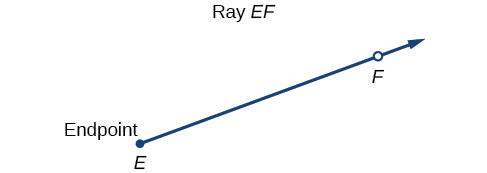
Effigy 1.
An bending is the matrimony of two rays having a common endpoint. The endpoint is called the vertex of the angle, and the 2 rays are the sides of the angle. The angle in (Figure) is formed from[latex]\,\stackrel{⟶}{ED}\,[/latex]and[latex]\,\stackrel{⟶}{EF}\,[/latex]. Angles can be named using a point on each ray and the vertex, such as bending DEF, or in symbol form[latex]\,\bending DEF.[/latex]
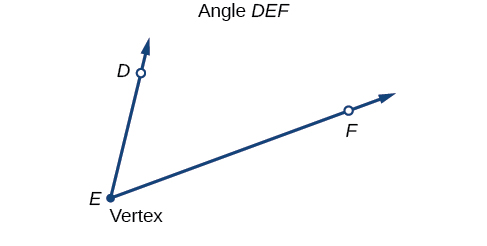
Effigy two.
Greek letters are often used as variables for the mensurate of an angle. (Figure) is a list of Greek messages commonly used to represent angles, and a sample angle is shown in (Figure).
| [latex]\theta [/latex] | [latex]\phi \,[/latex]or[latex]\,\varphi [/latex] | [latex]\alpha [/latex] | [latex]\beta [/latex] | [latex]\gamma [/latex] |
|---|---|---|---|---|
| theta | phi | alpha | beta | gamma |
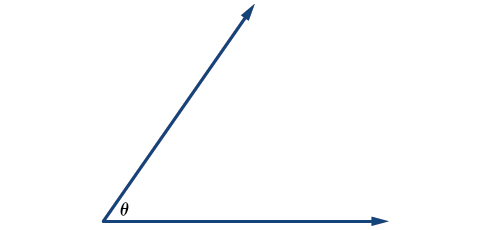
Figure iii. Angle theta, shown equally[latex]\,\angle \theta [/latex]
Angle creation is a dynamic process. We showtime with ii rays lying on acme of one some other. We get out one stock-still in place, and rotate the other. The fixed ray is the initial side, and the rotated ray is the last side. In order to identify the different sides, nosotros indicate the rotation with a modest arrow shut to the vertex equally in (Figure).
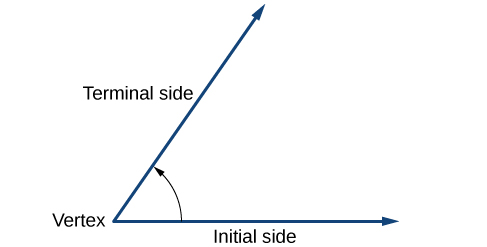
Effigy 4.
Equally we discussed at the beginning of the section, there are many applications for angles, but in order to employ them correctly, nosotros must be able to mensurate them. The measure of an bending is the amount of rotation from the initial side to the final side. Probably the virtually familiar unit of bending measurement is the degree. One caste is[latex]\,\frac{ane}{360}\,[/latex]of a round rotation, so a complete round rotation contains[latex]\,360\,[/latex]degrees. An angle measured in degrees should always include the unit "degrees" after the number, or include the degree symbol[latex]°.\,[/latex]For example,[latex]\,90\text{ degrees}=xc°.[/latex]
To formalize our work, we will begin past cartoon angles on an x–y coordinate plane. Angles can occur in whatever position on the coordinate plane, but for the purpose of comparison, the convention is to illustrate them in the aforementioned position whenever possible. An bending is in standard position if its vertex is located at the origin, and its initial side extends along the positive x-axis. See (Figure).
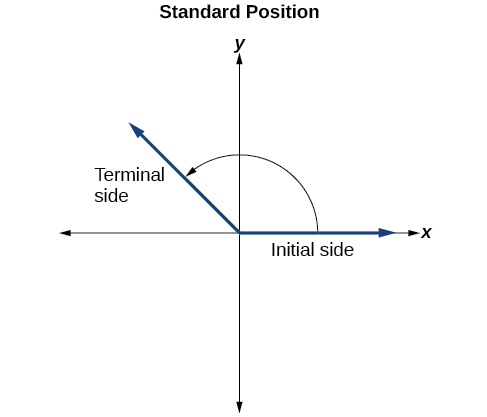
Figure 5.
If the angle is measured in a counterclockwise management from the initial side to the terminal side, the angle is said to be a positive angle. If the angle is measured in a clockwise direction, the angle is said to be a negative angle.
Drawing an angle in standard position e'er starts the aforementioned manner—draw the initial side along the positive 10-axis. To place the terminal side of the angle, nosotros must calculate the fraction of a total rotation the angle represents. We do that by dividing the bending measure in degrees past[latex]\,360°.\,[/latex]For case, to draw a[latex]\,xc°\,[/latex]angle, we summate that[latex]\,\frac{xc°}{360°}=\frac{1}{4}.\,[/latex]So, the last side will be one-fourth of the way around the circle, moving counterclockwise from the positive x-axis. To describe a[latex]\,360°[/latex]angle, nosotros calculate that[latex]\,\frac{360°}{360°}=one.\,[/latex]So the concluding side volition exist i consummate rotation around the circle, moving counterclockwise from the positive x-axis. In this case, the initial side and the terminal side overlap. See (Figure).
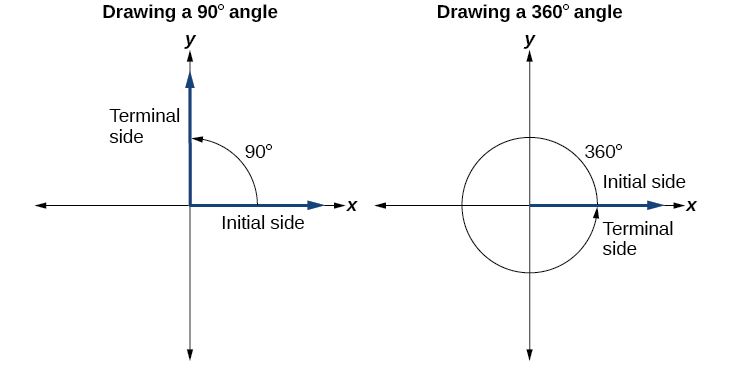
Figure vi.
Since we ascertain an bending in standard position by its concluding side, nosotros have a special type of angle whose terminal side lies on an axis, a quadrantal bending. This type of angle tin have a measure of[latex]\text{0°,}\,\text{90°,}\,\text{180°,}\,\text{270°,}[/latex]or[latex]\,\text{360°}.\,[/latex]Run into (Figure).
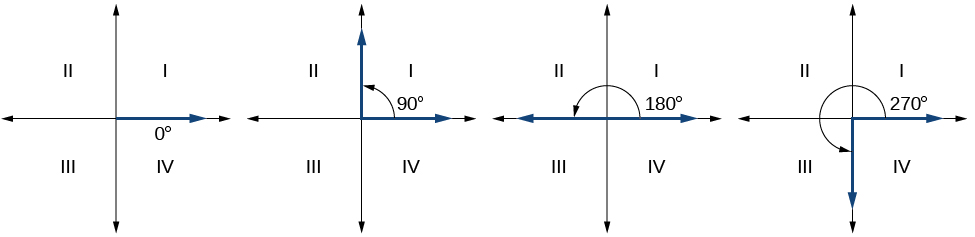
Effigy 7. Quadrantal angles have a terminal side that lies forth an axis. Examples are shown.
Quadrantal Angles
An angle is a quadrantal bending if its terminal side lies on an axis, including[latex]\text{0°,}\,\text{90°,}\,\text{180°,}\,\text{270°,}[/latex]or[latex]\,\text{360°}.[/latex]
How To
Given an angle mensurate in degrees, draw the angle in standard position.
- Limited the angle measure equally a fraction of[latex]\,\text{360°}.[/latex]
- Reduce the fraction to simplest form.
- Draw an angle that contains that same fraction of the circle, beginning on the positive ten-centrality and moving counterclockwise for positive angles and clockwise for negative angles.
Drawing an Angle in Standard Position Measured in Degrees
- Sketch an angle of[latex]\,thirty°\,[/latex]in standard position.
- Sketch an angle of[latex]\,-135°\,[/latex]in standard position.
Try It
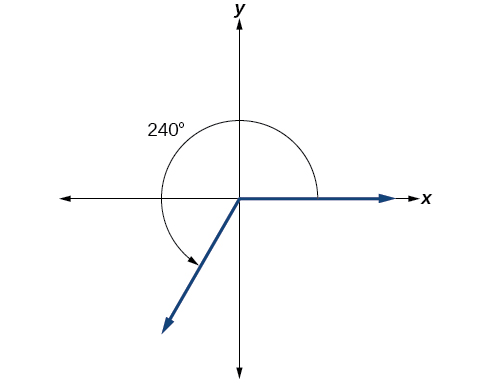
Show an bending of[latex]\,240°\,[/latex]on a circle in standard position.
Show Solution
Converting Between Degrees and Radians
Dividing a circle into 360 parts is an capricious option, although it creates the familiar degree measurement. Nosotros may choose other ways to divide a circle. To find another unit, think of the process of cartoon a circle. Imagine that you stop before the circle is completed. The portion that you drew is referred to as an arc. An arc may be a portion of a total circle, a full circle, or more than a full circumvolve, represented by more than one full rotation. The length of the arc effectually an entire circle is chosen the circumference of that circle.
The circumference of a circle is[latex]\,C=ii\pi r.\,[/latex]If we divide both sides of this equation past[latex]\,r,[/latex]we create the ratio of the circumference, which is always[latex]\,two\pi ,[/latex]to the radius, regardless of the length of the radius. And so the circumference of any circumvolve is[latex]\,2\pi \approx 6.28\,[/latex]times the length of the radius. That ways that if we took a string equally long as the radius and used it to mensurate sequent lengths around the circumference, there would be room for half dozen full string-lengths and a little more a quarter of a seventh, as shown in (Effigy).
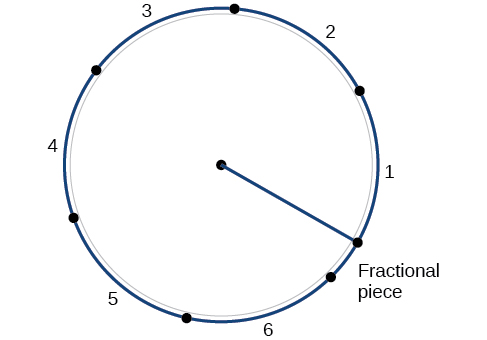
Figure ten.
This brings us to our new angle measure. One radian is the measure of a central angle of a circumvolve that intercepts an arc equal in length to the radius of that circle. A central angle is an angle formed at the center of a circle by two radii. Because the total circumference equals[latex]\,2\pi \,[/latex]times the radius, a full circular rotation is[latex]\,ii\pi \,[/latex]radians.
[latex]\brainstorm{array}{ccc}\hfill 2\pi \text{ radians}& =& 360°\hfill \\ \hfill \pi \text{ radians}& =& \frac{360°}{2}=180°\hfill \\ \hfill i\text{ radian}& =& \frac{180°}{\pi }\approx 57.3°\hfill \end{assortment}[/latex]
See (Figure). Notation that when an angle is described without a specific unit, it refers to radian measure out. For example, an angle measure of 3 indicates iii radians. In fact, radian measure is dimensionless, since it is the caliber of a length (circumference) divided by a length (radius) and the length units cancel.
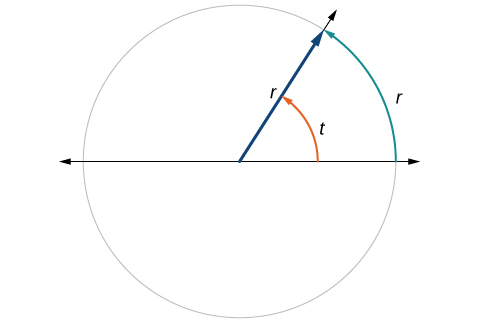
Effigy xi. The bending[latex]\,t\,[/latex]sweeps out a mensurate of 1 radian. Note that the length of the intercepted arc is the aforementioned as the length of the radius of the circumvolve.
Relating Arc Lengths to Radius
An arc length[latex]\,s\,[/latex]is the length of the curve along the arc. Just as the full circumference of a circle always has a constant ratio to the radius, the arc length produced past any given angle also has a constant relation to the radius, regardless of the length of the radius.
This ratio, called the radian measure out, is the same regardless of the radius of the circle—it depends only on the bending. This property allows u.s. to ascertain a mensurate of any angle equally the ratio of the arc length[latex]\,south\,[/latex]to the radius r. See (Effigy).
[latex]\brainstorm{array}{ccc}s& =& r\theta \\ \theta & =& \frac{s}{r}\end{array}[/latex]
If[latex]\,south=r,[/latex]then[latex]\,\theta =\frac{r}{r}=\text{ 1 radian}\text{.}[/latex]
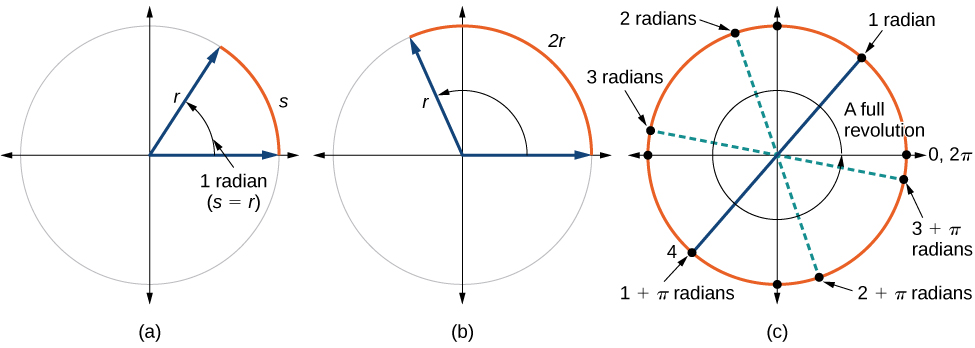
Figure 12. (a) In an angle of ane radian, the arc length[latex]\,s\,[/latex]equals the radius[latex]\,r.\,[/latex](b) An angle of 2 radians has an arc length[latex]\,s=2r.\,[/latex](c) A total revolution is[latex]\,2\pi ,[/latex]or about 6.28 radians.
To elaborate on this idea, consider ii circles, one with radius two and the other with radius 3. Recall the circumference of a circumvolve is[latex]\,C=2\pi r,[/latex]where[latex]\,r\,[/latex]is the radius. The smaller circumvolve and then has circumference[latex]\,2\pi \left(ii\right)=4\pi \,[/latex]and the larger has circumference[latex]\,ii\pi \left(iii\right)=six\pi .\,[/latex]At present nosotros draw a[latex]\,45°\,[/latex]angle on the two circles, as in (Figure).
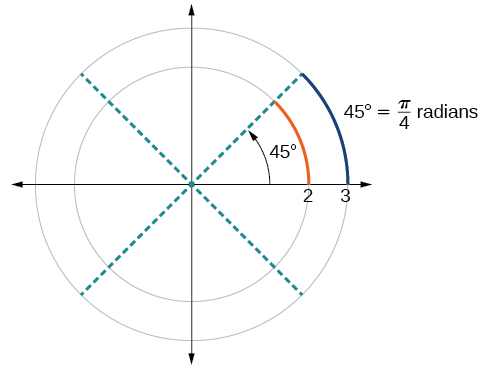
Figure 13. A[latex]\,45°\,[/latex]angle contains one-eighth of the circumference of a circle, regardless of the radius.
Notice what happens if we find the ratio of the arc length divided by the radius of the circle.
[latex]\brainstorm{array}{ccc}\text{Smaller circle: }\frac{\frac{1}{ii}\pi }{2}& =& \frac{1}{4}\pi \\ \text{Larger circle: }\frac{\frac{3}{4}\pi }{3}& =& \frac{one}{4}\pi \cease{array}[/latex]
Since both ratios are[latex]\,\frac{1}{4}\pi ,[/latex]the angle measures of both circles are the same, even though the arc length and radius differ.
Radians
One radian is the measure of the central angle of a circumvolve such that the length of the arc between the initial side and the terminal side is equal to the radius of the circle. A full revolution[latex]\,\left(360°\right)\,[/latex]equals[latex]\,two\pi \,[/latex]radians. A one-half revolution[latex]\,\left(180°\right)\,[/latex]is equivalent to[latex]\,\pi \,[/latex]radians.
The radian measure of an angle is the ratio of the length of the arc subtended by the angle to the radius of the circumvolve. In other words, if[latex]\,s\,[/latex]is the length of an arc of a circle, and[latex]\,r\,[/latex]is the radius of the circle, then the central bending containing that arc measures[latex]\,\frac{s}{r}\,[/latex]radians. In a circle of radius 1, the radian measure corresponds to the length of the arc.
A measure of 1 radian looks to be well-nigh[latex]\,60°.\,[/latex]Is that correct?
Aye. It is approximately[latex]\,57.iii°.\,[/latex]Because[latex]\,ii\pi \,[/latex]radians equals[latex]360°,one[/latex]radian equals[latex]\,\frac{360°}{2\pi }\approx 57.iii°.[/latex]
Using Radians
Because radian measure is the ratio of two lengths, information technology is a unitless measure. For example, in (Figure), suppose the radius were 2 inches and the distance forth the arc were also 2 inches. When nosotros calculate the radian measure of the angle, the "inches" abolish, and we have a result without units. Therefore, information technology is non necessary to write the label "radians" after a radian measure, and if we see an angle that is non labeled with "degrees" or the degree symbol, we tin assume that it is a radian measure.
Considering the most basic case, the unit of measurement circle (a circle with radius ane), we know that one rotation equals 360 degrees,[latex]\,360°.[/latex]Nosotros can also track i rotation around a circle by finding the circumference,[latex]\,C=two\pi r,[/latex]and for the unit circumvolve[latex]\,C=2\pi .\,[/latex]These 2 different ways to rotate around a circle give us a way to convert from degrees to radians.
[latex]\begin{array}{ccccc}\hfill \text{1 rotation}& =& 360°\hfill & =& 2\pi \text{ radians}\hfill \\ \hfill \frac{1}{two}\text{ rotation}& =& 180°\hfill & =& \pi \text{ radians}\hfill \\ \hfill \frac{i}{four}\text{ rotation}& =& 90°\hfill & =& \frac{\pi }{2}\text{ radians}\hfill \cease{array}[/latex]
Identifying Special Angles Measured in Radians
In add-on to knowing the measurements in degrees and radians of a quarter revolution, a one-half revolution, and a full revolution, there are other often encountered angles in ane revolution of a circumvolve with which we should be familiar. It is mutual to meet multiples of 30, 45, 60, and 90 degrees. These values are shown in (Effigy). Memorizing these angles will be very useful as we written report the properties associated with angles.
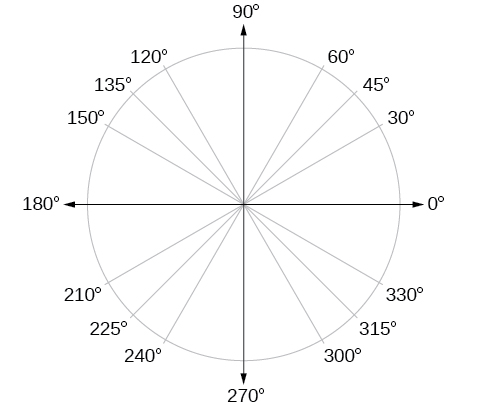
Effigy 14. Commonly encountered angles measured in degrees
Now, nosotros can listing the corresponding radian values for the common measures of a circle corresponding to those listed in (Figure), which are shown in (Figure). Be sure you tin can verify each of these measures.
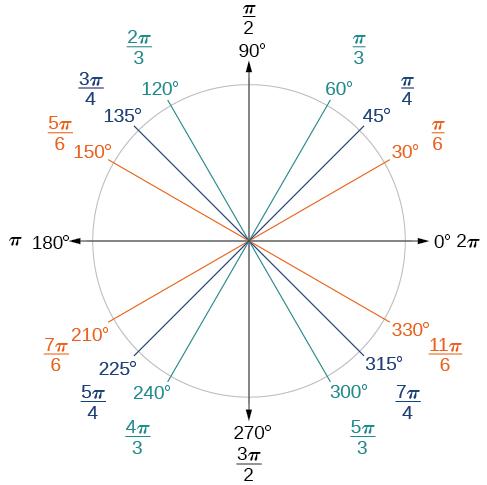
Figure xv. Ordinarily encountered angles measured in radians
Finding a Radian Measure
Detect the radian measure of one-third of a full rotation.
Endeavour It
Find the radian measure of three-fourths of a full rotation.
Testify Solution
[latex]\frac{3\pi }{2}[/latex]
Converting Between Radians and Degrees
Because degrees and radians both measure angles, nosotros demand to be able to convert betwixt them. We can easily do so using a proportion where[latex]\,\theta \,[/latex]is the mensurate of the angle in degrees and[latex]\,{\theta }_{R}\,[/latex]is the measure of the bending in radians.
[latex]\frac{\theta }{180}=\frac{{\theta }_{{}^{R}}}{\pi }[/latex]
This proportion shows that the measure of angle[latex]\,\theta \,[/latex]in degrees divided by 180 equals the measure of bending[latex]\,\theta \,[/latex]in radians divided past[latex]\,\pi .\,[/latex]Or, phrased another way, degrees is to 180 as radians is to[latex]\,\pi .[/latex]
[latex]\frac{\text{Degrees}}{180}=\frac{\text{Radians}}{\pi }[/latex]
Converting between Radians and Degrees
To catechumen between degrees and radians, utilize the proportion
[latex]\frac{\theta }{180}=\frac{{\theta }_{R}}{\pi }[/latex]
Converting Radians to Degrees
Convert each radian measure to degrees.
- [latex]\frac{\pi }{6}[/latex]
- iii
Try It
Convert[latex]\,-\frac{3\pi }{4}\,[/latex]radians to degrees.
Show Solution
[latex]-135°[/latex]
Converting Degrees to Radians
Convert[latex]\,15\,[/latex]degrees to radians.
Analysis
Another way to recall nearly this trouble is by remembering that[latex]\,30°=\frac{\pi }{vi}.\,[/latex]Because[latex]\,fifteen°=\frac{1}{ii}\left(30°\right),[/latex]we can find that[latex]\,\frac{1}{ii}\left(\frac{\pi }{6}\right)\,[/latex]is[latex]\,\frac{\pi }{12}.[/latex]
Try Information technology
Convert[latex]\,126°\,[/latex]to radians.
Show Solution
[latex]\frac{7\pi }{10}[/latex]
Finding Coterminal Angles
Converting between degrees and radians can make working with angles easier in some applications. For other applications, we may demand some other blazon of conversion. Negative angles and angles greater than a full revolution are more awkward to piece of work with than those in the range of[latex]\,0°\,[/latex]to[latex]\,360°,[/latex]or[latex]\,0\,[/latex]to[latex]\,2\pi .\,[/latex]Information technology would exist convenient to supercede those out-of-range angles with a respective angle within the range of a single revolution.
It is possible for more i bending to have the same concluding side. Look at (Figure). The angle of[latex]\,140°\,[/latex]is a positive bending, measured counterclockwise. The angle of[latex]\,–220°\,[/latex]is a negative bending, measured clockwise. But both angles take the aforementioned terminal side. If ii angles in standard position have the same concluding side, they are coterminal angles. Every angle greater than[latex]\,360°\,[/latex]or less than[latex]\,0°\,[/latex]is coterminal with an angle betwixt[latex]\,0°\,[/latex]and[latex]\,360°,[/latex]and it is often more convenient to detect the coterminal angle within the range of[latex]\,0°\,[/latex]to[latex]\,360°\,[/latex]than to work with an bending that is outside that range.
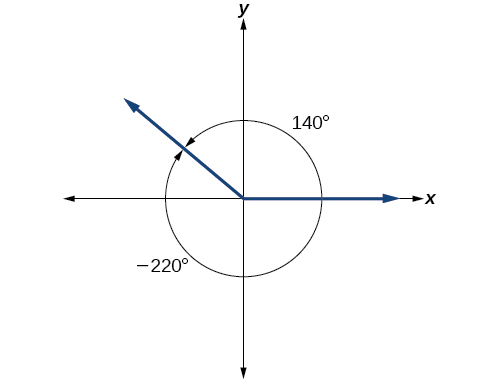
Figure sixteen. An angle of[latex]\,140°\,[/latex]and an bending of[latex]\,–220°\,[/latex]are coterminal angles.
Any angle has infinitely many coterminal angles considering each fourth dimension we add together[latex]\,360°\,[/latex]to that bending—or subtract[latex]\,360°\,[/latex]from it—the resulting value has a terminal side in the same location. For instance,[latex]\,\text{100°}\,[/latex]and[latex]\,\text{460°}\,[/latex]are coterminal for this reason, as is[latex]\,-260°.\,[/latex]
An angle'due south reference angle is the measure of the smallest, positive, acute bending[latex]\,t\,[/latex]formed by the terminal side of the angle[latex]\,t\,[/latex]and the horizontal axis. Thus positive reference angles take terminal sides that lie in the commencement quadrant and can exist used as models for angles in other quadrants. See (Figure) for examples of reference angles for angles in different quadrants.
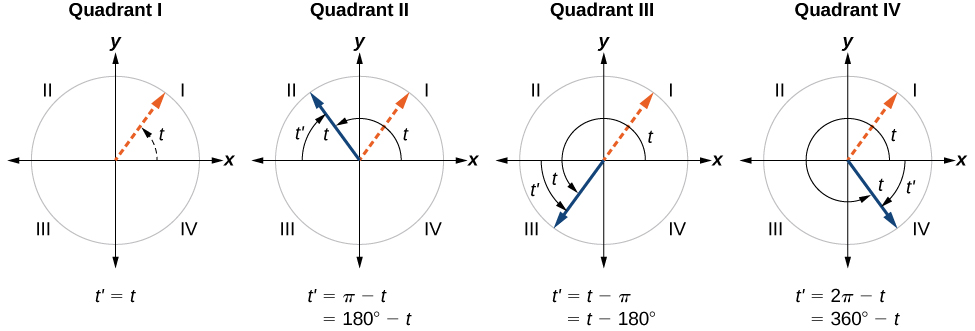
Figure 17.
Coterminal and Reference Angles
Coterminal angles are two angles in standard position that have the same terminal side.
An angle'southward reference bending is the size of the smallest acute angle,[latex]\,{t}^{\prime },[/latex]formed by the terminal side of the angle[latex]\,t\,[/latex]and the horizontal axis.
How To
Given an angle greater than[latex]\,360°,[/latex]observe a coterminal bending between[latex]\,0°\,[/latex]and[latex]\,360°[/latex]
- Subtract[latex]\,360°\,[/latex]from the given bending.
- If the upshot is still greater than[latex]\,360°,[/latex]subtract[latex]\,360°\,[/latex]again till the result is between[latex]\,0°\,[/latex]and[latex]\,360°.[/latex]
- The resulting angle is coterminal with the original angle.
Finding an Bending Coterminal with an Bending of Measure out Greater Than[latex]\,360°[/latex]
Find the least positive angle[latex]\,\theta \,[/latex]that is coterminal with an angle measuring[latex]\,800°,[/latex]where[latex]\,0°\le \theta <360°.[/latex]
Try It
Find an angle[latex]\,\alpha \,[/latex]that is coterminal with an angle measuring [latex]\,870°,[/latex]where[latex]\,0°\le \alpha <360°.[/latex]
Show Solution
[latex]\alpha =150°[/latex]
How To
Given an angle with measure less than[latex]\,0°,[/latex]discover a coterminal bending having a measure between[latex]\,0°\,[/latex]and[latex]\,360°.[/latex]
- Add together[latex]\,360°\,[/latex]to the given bending.
- If the result is nonetheless less than[latex]\,0°,[/latex]add[latex]\,360°\,[/latex]once more until the result is betwixt[latex]\,0°\,[/latex]and[latex]\,360°.[/latex]
- The resulting angle is coterminal with the original bending.
Finding an Angle Coterminal with an Angle Measuring Less Than[latex]\,0°[/latex]
Show the angle with mensurate[latex]\,-45°\,[/latex]on a circumvolve and notice a positive coterminal angle[latex]\,\alpha \,[/latex]such that[latex]\,0°\le \blastoff <360°.[/latex]
Try It
Detect an angle[latex]\,\beta \,[/latex]that is coterminal with an angle measuring[latex]\,-300°\,[/latex]such that[latex]\,0°\le \beta <360°.[/latex]
Bear witness Solution
[latex]\beta =sixty°[/latex]
Finding Coterminal Angles Measured in Radians
Nosotros tin can detect coterminal angles measured in radians in much the aforementioned way as nosotros have found them using degrees. In both cases, we detect coterminal angles by calculation or subtracting 1 or more full rotations.
How To
Given an angle greater than[latex]\,2\pi ,[/latex]find a coterminal angle between 0 and[latex]\,2\pi .[/latex]
- Subtract[latex]\,2\pi \,[/latex]from the given angle.
- If the result is still greater than[latex]\,2\pi ,[/latex]subtract[latex]\,2\pi \,[/latex]again until the result is between[latex]\,0\,[/latex]and[latex]\,2\pi .[/latex]
- The resulting angle is coterminal with the original angle.
Finding Coterminal Angles Using Radians
Find an angle[latex]\,\beta \,[/latex]that is coterminal with[latex]\,\frac{19\pi }{4},[/latex]where[latex]\,0\le \beta <two\pi .[/latex]
Endeavour It
Observe an angle of mensurate[latex]\,\theta \,[/latex]that is coterminal with an angle of measure[latex]\,-\frac{17\pi }{6}\,[/latex]where[latex]\,0\le \theta <ii\pi .[/latex]
Bear witness Solution
[latex]\,\frac{vii\pi }{6}\,[/latex]
Determining the Length of an Arc
Recall that the radian mensurate[latex]\,\theta \,[/latex]of an angle was defined equally the ratio of the arc length[latex]\,southward\,[/latex]of a circular arc to the radius[latex]\,r\,[/latex]of the circle,[latex]\,\theta =\frac{s}{r}.\,[/latex]From this relationship, we can find arc length along a circumvolve, given an angle.
Arc Length on a Circumvolve
In a circle of radius r, the length of an arc[latex]\,southward\,[/latex]subtended by an bending with measure[latex]\,\theta \,[/latex]in radians, shown in (Figure), is
[latex]s=r\theta [/latex]

Effigy 21.
How To
Given a circle of radius[latex]\,r,[/latex]calculate the length[latex]\,due south\,[/latex]of the arc subtended by a given angle of measure out[latex]\,\theta .[/latex]
- If necessary, convert[latex]\,\theta \,[/latex]to radians.
- Multiply the radius[latex]\,r\,\,\theta :south=r\theta .[/latex]
Finding the Length of an Arc
Assume the orbit of Mercury effectually the sun is a perfect circumvolve. Mercury is approximately 36 million miles from the sun.
- In i Globe day, Mercury completes 0.0114 of its total revolution. How many miles does it travel in one day?
- Use your answer from part (a) to make up one's mind the radian mensurate for Mercury's movement in one Earth day.
Endeavor Information technology
Find the arc length along a circle of radius ten units subtended by an angle of[latex]\,215°.[/latex]
Testify Solution
[latex]\frac{215\pi }{18}=37.525\text{ units}[/latex]
Finding the Area of a Sector of a Circle
In addition to arc length, we tin can also use angles to find the area of a sector of a circle. A sector is a region of a circle divisional by two radii and the intercepted arc, like a slice of pizza or pie. Recall that the surface area of a circle with radius[latex]\,r\,[/latex]can be institute using the formula[latex]\,A=\pi {r}^{two}.\,[/latex]If the 2 radii form an angle of[latex]\,\theta ,[/latex]measured in radians, then[latex]\,\frac{\theta }{ii\pi }\,[/latex]is the ratio of the angle measure to the measure of a full rotation and is also, therefore, the ratio of the surface area of the sector to the area of the circumvolve. Thus, the area of a sector is the fraction[latex]\,\frac{\theta }{2\pi }\,[/latex]multiplied by the unabridged area. (Always remember that this formula only applies if[latex]\,\theta \,[/latex]is in radians.)
[latex]\begin{array}{ccc}\hfill \text{Expanse of sector}& =& \left(\frac{\theta }{2\pi }\right)\pi {r}^{two}\hfill \\ & =& \frac{\theta \pi {r}^{2}}{2\pi }\hfill \\ & =& \frac{i}{2}\theta {r}^{2}\hfill \end{array}[/latex]
Area of a Sector
The area of a sector of a circle with radius[latex]\,r\,[/latex]subtended by an angle[latex]\,\theta ,[/latex]measured in radians, is
[latex]A=\frac{1}{ii}\theta {r}^{2}[/latex]
See (Figure).

Figure 22. The surface area of the sector equals one-half the square of the radius times the central angle measured in radians.
How To
Given a circle of radius[latex]\,r,[/latex]find the area of a sector defined by a given angle[latex]\,\theta .[/latex]
- If necessary, catechumen[latex]\,\theta \,[/latex]to radians.
- Multiply half the radian measure of[latex]\,\theta \,[/latex]by the foursquare of the radius[latex]\,r:\text{}A=\frac{i}{2}\theta {r}^{2}.[/latex]
Finding the Surface area of a Sector
An automatic backyard sprinkler sprays a distance of 20 anxiety while rotating 30 degrees, equally shown in (Effigy). What is the area of the sector of grass the sprinkler waters?

Effigy 23. The sprinkler sprays 20 ft inside an arc of[latex]\,30°.[/latex]
Try It
In central pivot irrigation, a large irrigation pipage on wheels rotates around a center point. A farmer has a central pivot system with a radius of 400 meters. If water restrictions only allow her to h2o 150 thousand foursquare meters a day, what angle should she set the arrangement to embrace? Write the answer in radian measure out to two decimal places.
Use Linear and Athwart Speed to Describe Motility on a Circular Path
In improver to finding the area of a sector, we tin can utilize angles to describe the speed of a moving object. An object traveling in a circular path has two types of speed. Linear speed is speed along a direct path and can be determined by the altitude it moves along (its displacement) in a given time interval. For instance, if a cycle with radius 5 inches rotates once a 2d, a betoken on the edge of the bike moves a distance equal to the circumference, or[latex]\,10\pi \,[/latex]inches, every second. So the linear speed of the point is[latex]\,10\pi \,[/latex]in./s. The equation for linear speed is equally follows where[latex]\,5\,[/latex]is linear speed,[latex]\,s\,[/latex]is displacement, and[latex]\,t\,[/latex]is time.
[latex]v=\frac{south}{t}[/latex]
Angular speed results from circular motion and can be determined past the angle through which a point rotates in a given fourth dimension interval. In other words, angular speed is angular rotation per unit time. So, for instance, if a gear makes a full rotation every four seconds, nosotros tin calculate its athwart speed equally[latex]\,\frac{360\text{ degrees}}{iv\text{ seconds}}=[/latex]90 degrees per second. Angular speed can be given in radians per 2d, rotations per infinitesimal, or degrees per hour for instance. The equation for angular speed is as follows, where[latex]\,\omega \,[/latex](read as omega) is angular speed,[latex]\,\theta \,[/latex]is the bending traversed, and[latex]\,t\,[/latex]is time.
[latex]\omega =\frac{\theta }{t}[/latex]
Combining the definition of angular speed with the arc length equation,[latex]\,s=r\theta ,[/latex]nosotros can notice a relationship between angular and linear speeds. The angular speed equation can exist solved for[latex]\,\theta ,[/latex]giving[latex]\,\theta =\omega t.[/latex]Substituting this into the arc length equation gives:
[latex]\begin{array}{ccc}\hfill s& =& r\theta \hfill \\ & =& r\omega t\hfill \stop{array}[/latex]
Substituting this into the linear speed equation gives:
[latex]\begin{array}{ccc}\hfill v& =& \frac{s}{t}\hfill \\ & =& \frac{r\omega t}{t}\hfill \\ & =& r\omega \hfill \end{assortment}[/latex]
Angular and Linear Speed
Equally a bespeak moves forth a circle of radius[latex]\,r,[/latex]its athwart speed,[latex]\,\omega ,[/latex]is the angular rotation[latex]\,\theta \,[/latex]per unit of measurement time,[latex]\,t.[/latex]
[latex]\omega =\frac{\theta }{t}[/latex]
The linear speed, [latex]\,v,[/latex]of the signal tin can be found equally the distance traveled, arc length[latex]\,s,[/latex]per unit of measurement time,[latex]\,t.[/latex]
[latex]5=\frac{southward}{t}[/latex]
When the angular speed is measured in radians per unit time, linear speed and angular speed are related by the equation
[latex]v=r\omega [/latex]
This equation states that the angular speed in radians,[latex]\,\omega ,[/latex]representing the amount of rotation occurring in a unit of fourth dimension, can be multiplied by the radius[latex]\,r\,[/latex]to summate the total arc length traveled in a unit of time, which is the definition of linear speed.
How To
Given the amount of bending rotation and the time elapsed, calculate the angular speed.
- If necessary, convert the angle measure to radians.
- Dissever the angle in radians by the number of time units elapsed:[latex]\,\omega =\frac{\theta }{t}.[/latex]
- The resulting speed will be in radians per time unit.
Finding Angular Speed
A water wheel, shown in (Figure), completes 1 rotation every 5 seconds. Notice the angular speed in radians per second.
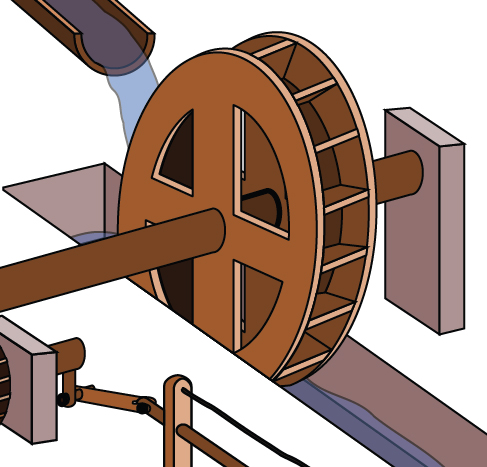
Figure 24.
Show Solution
The wheel completes ane rotation, or passes through an bending of[latex]\,2\pi \,[/latex]radians in 5 seconds, so the athwart speed would be[latex]\,\omega =\frac{2\pi }{5}\approx 1.257\,[/latex]radians per 2d.
Attempt Information technology
An one-time vinyl record is played on a turntable rotating clockwise at a rate of 45 rotations per minute. Discover the athwart speed in radians per second.
Show Solution
[latex]\frac{-3\pi }{2}\,[/latex]rad/south
How To
Given the radius of a circle, an angle of rotation, and a length of elapsed time, determine the linear speed.
- Convert the total rotation to radians if necessary.
- Divide the total rotation in radians by the elapsed time to detect the angular speed: apply[latex]\,\omega =\frac{\theta }{t}.[/latex]
- Multiply the angular speed by the length of the radius to find the linear speed, expressed in terms of the length unit used for the radius and the time unit used for the elapsed fourth dimension: use[latex]\,v=r\omega .[/latex]
Finding a Linear Speed
A bicycle has wheels 28 inches in diameter. A tachometer determines the wheels are rotating at 180 RPM (revolutions per infinitesimal). Find the speed the bicycle is traveling down the road.
Try Information technology
A satellite is rotating around Earth at 0.25 radian per hour at an altitude of 242 km above Earth. If the radius of World is 6378 kilometers, discover the linear speed of the satellite in kilometers per hr.
Testify Solution
1655 kilometers per hour
Cardinal Equations
| arc length | [latex]s=r\theta [/latex] |
| area of a sector | [latex]A=\frac{1}{2}\theta {r}^{2}[/latex] |
| angular speed | [latex]\omega =\frac{\theta }{t}[/latex] |
| linear speed | [latex]five=\frac{s}{t}[/latex] |
| linear speed related to angular speed | [latex]v=r\omega [/latex] |
Key Concepts
- An angle is formed from the union of two rays, by keeping the initial side fixed and rotating the terminal side. The corporeality of rotation determines the measure of the angle.
- An angle is in standard position if its vertex is at the origin and its initial side lies along the positive x-axis. A positive angle is measured counterclockwise from the initial side and a negative angle is measured clockwise.
- To draw an angle in standard position, draw the initial side forth the positive x-centrality and so place the terminal side according to the fraction of a full rotation the angle represents. Come across (Figure).
- In addition to degrees, the measure out of an angle can be described in radians. See (Figure).
- To convert between degrees and radians, utilize the proportion[latex]\,\frac{\theta }{180}=\frac{{\theta }_{R}}{\pi }.\,[/latex]See (Figure) and (Figure).
- Two angles that have the same terminal side are called coterminal angles.
- We tin can find coterminal angles by adding or subtracting[latex]\,360°\,[/latex]or[latex]\,ii\pi .\,[/latex]Encounter (Figure) and (Effigy).
- Coterminal angles tin be found using radians just as they are for degrees. Run across (Figure).
- The length of a circular arc is a fraction of the circumference of the unabridged circle. Run across (Figure).
- The area of sector is a fraction of the area of the unabridged circle. See (Figure).
- An object moving in a circular path has both linear and angular speed.
- The angular speed of an object traveling in a circular path is the mensurate of the bending through which it turns in a unit of measurement of time. Come across (Figure).
- The linear speed of an object traveling along a circular path is the altitude information technology travels in a unit of fourth dimension. See (Figure).
Section Exercises
Verbal
Draw an bending in standard position. Label the vertex, initial side, and terminal side.
Show Solution
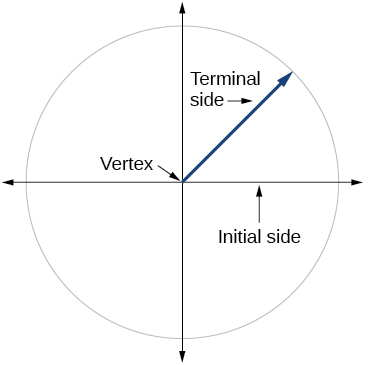
Explain why in that location are an infinite number of angles that are coterminal to a certain angle.
State what a positive or negative angle signifies, and explain how to draw each.
Bear witness Solution
Whether the angle is positive or negative determines the direction. A positive angle is fatigued in the counterclockwise direction, and a negative angle is fatigued in the clockwise direction.
How does radian mensurate of an angle compare to the degree measure? Include an explanation of one radian in your paragraph.
Explain the differences between linear speed and angular speed when describing motion forth a circular path.
Show Solution
Linear speed is a measurement found by calculating distance of an arc compared to time. Angular speed is a measurement institute by calculating the angle of an arc compared to fourth dimension.
Graphical
For the post-obit exercises, describe an angle in standard position with the given measure.
[latex]300°[/latex]
Show Solution
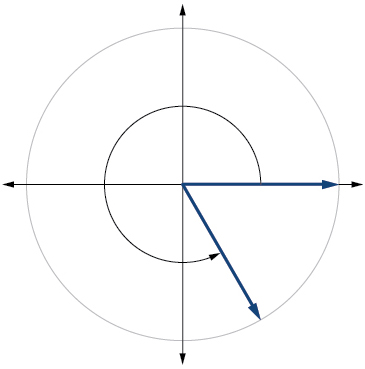
[latex]135°[/latex]
Show Solution
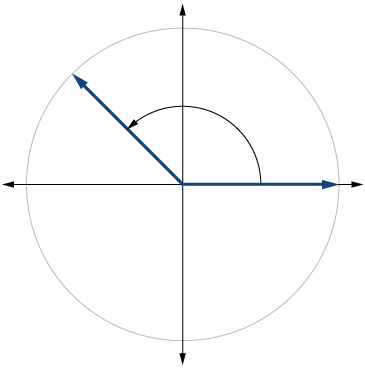
[latex]\frac{2\pi }{3}[/latex]
Show Solution
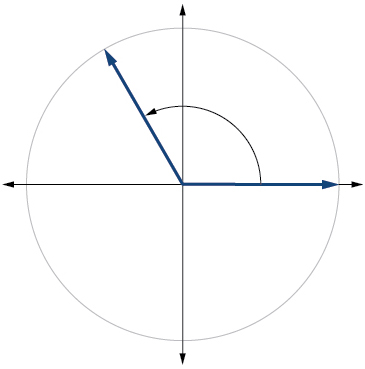
[latex]\frac{vii\pi }{4}[/latex]
[latex]\frac{5\pi }{6}[/latex]
Bear witness Solution
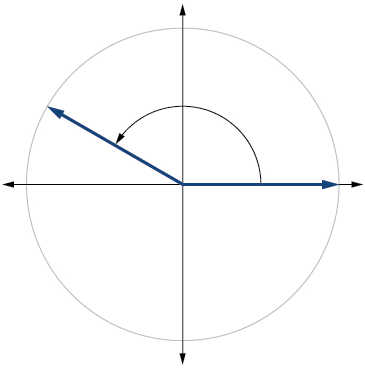
[latex]\frac{\pi }{ii}[/latex]
[latex]-\frac{\pi }{10}[/latex]
Show Solution
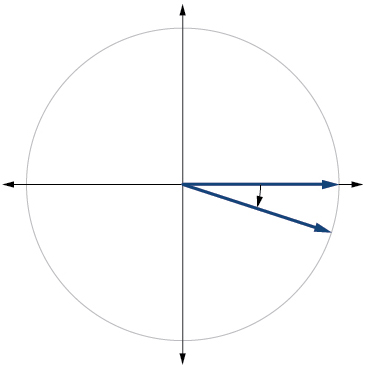
[latex]\frac{22\pi }{3}[/latex]
[latex]-\frac{\pi }{6}[/latex]
[latex]-\frac{4\pi }{3}[/latex]
For the post-obit exercises, refer to (Figure). Circular to 2 decimal places.
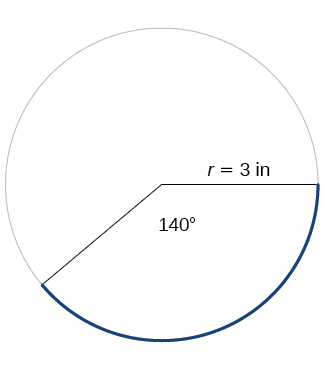
Effigy 25.
Find the area of the sector.
Testify Solution
[latex]\frac{vii\pi }{2}\approx 11.00{\text{ in}}^{2}[/latex]
For the following exercises, refer to (Figure). Round to two decimal places.
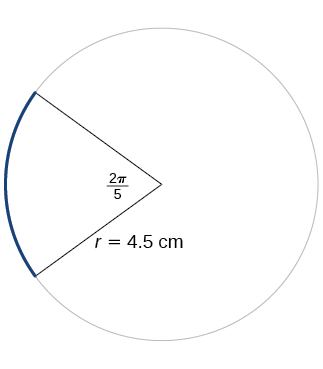
Effigy 26.
Detect the area of the sector.
Show Solution
[latex]\frac{81\pi }{twenty}\approx 12.72{\text{ cm}}^{2}[/latex]
Algebraic
For the following exercises, convert angles in radians to degrees.
[latex]\frac{3\pi }{4}\,[/latex]radians
[latex]\frac{\pi }{9}\,[/latex]radians
Testify Solution
[latex]xx°[/latex]
[latex]-\frac{5\pi }{four}\,[/latex]radians
[latex]\frac{\pi }{3}\,[/latex]radians
Bear witness Solution
[latex]threescore°[/latex]
[latex]-\frac{7\pi }{3}\,[/latex]radians
[latex]-\frac{five\pi }{12}\,[/latex]radians
Show Solution
[latex]-75°[/latex]
[latex]\frac{eleven\pi }{6}\,[/latex]radians
For the following exercises, convert angles in degrees to radians.
[latex]90°[/latex]
Testify Solution
[latex]\frac{\pi }{2}\,[/latex]radians
[latex]-540°[/latex]
Show Solution
[latex]-3\pi \,[/latex]radians
[latex]180°[/latex]
Show Solution
[latex]\pi \,[/latex]radians
[latex]150°[/latex]
Show Solution
[latex]\frac{5\pi }{half-dozen}[/latex]radians
For the following exercises, utilise the given information to detect the length of a circular arc. Circular to ii decimal places.
Find the length of the arc of a circle of radius 12 inches subtended by a central angle of[latex]\,\frac{\pi }{4}.\,[/latex]radians.
Find the length of the arc of a circle of radius five.02 miles subtended by the key bending of[latex]\,\frac{\pi }{3}.[/latex]
Show Solution
[latex]\frac{5.02\pi }{three}\approx 5.26\,[/latex]miles
Notice the length of the arc of a circle of bore xiv meters subtended by the central angle of[latex]\,\frac{v\pi }{6}.[/latex]
Detect the length of the arc of a circle of radius ten centimeters subtended past the central angle of[latex]\,50°.[/latex]
Show Solution
[latex]\frac{25\pi }{nine}\approx viii.73\,[/latex]centimeters
Observe the length of the arc of a circle of radius 5 inches subtended by the central angle of[latex]\,220°.[/latex]
Find the length of the arc of a circle of diameter 12 meters subtended past the primal angle is[latex]\,63°.[/latex]
Bear witness Solution
[latex]\frac{21\pi }{10}\approx 6.threescore\,[/latex]meters
For the following exercises, use the given data to find the area of the sector. Circular to 4 decimal places.
A sector of a circumvolve has a central angle of[latex]\,45°\,[/latex]and a radius six cm.
A sector of a circle has a central angle of[latex]\,30°\,[/latex]and a radius of xx cm.
Show Solution
104.7198 cm2
A sector of a circle with bore x anxiety and an angle of[latex]\,\frac{\pi }{2}\,[/latex]radians.
A sector of a circle with radius of 0.seven inches and an angle of[latex]\,\pi \,[/latex]radians.
For the following exercises, notice the angle between[latex]\,0°\,[/latex]and[latex]\,360°\,[/latex]that is coterminal to the given angle.
[latex]-110°[/latex]
Show Solution
[latex]250°[/latex]
[latex]1400°[/latex]
Testify Solution
[latex]320°[/latex]
For the post-obit exercises, find the bending between 0 and[latex]\,2\pi \,[/latex]in radians that is coterminal to the given angle.
[latex]-\frac{\pi }{nine}[/latex]
[latex]\frac{10\pi }{3}[/latex]
Testify Solution
[latex]\frac{four\pi }{three}[/latex]
[latex]\frac{thirteen\pi }{6}[/latex]
[latex]\frac{44\pi }{9}[/latex]
Show Solution
[latex]\frac{8\pi }{nine}[/latex]
Real-Earth Applications
A truck with 32-inch diameter wheels is traveling at sixty mi/h. Notice the athwart speed of the wheels in rad/min. How many revolutions per minute do the wheels make?
A bicycle with 24-inch diameter wheels is traveling at 15 mi/h. Notice the athwart speed of the wheels in rad/min. How many revolutions per infinitesimal exercise the wheels make?
Show Solution
[latex]1320\,[/latex]rad/min[latex]\,210.085\,[/latex] RPM
A bicycle of radius viii inches is rotating 15°/s. What is the linear speed[latex]\,five,[/latex]the angular speed in RPM, and the angular speed in rad/due south?
A wheel of radius[latex]\,14\,[/latex]inches is rotating[latex]\,0.5\,[/latex]rad/southward. What is the linear speed[latex]\,v,[/latex]the angular speed in RPM, and the angular speed in deg/s?
Show Solution
[latex]7\,[/latex]in./south, 4.77 RPM ,[latex]\,28.65\,[/latex]deg/southward
A CD has diameter of 120 millimeters. When playing sound, the angular speed varies to continue the linear speed constant where the disc is being read. When reading along the outer edge of the disc, the angular speed is about 200 RPM (revolutions per minute). Detect the linear speed.
When existence burned in a writable CD-R bulldoze, the angular speed of a CD is ofttimes much faster than when playing sound, but the angular speed still varies to go on the linear speed constant where the disc is existence written. When writing along the outer edge of the disc, the athwart speed of 1 drive is about 4800 RPM (revolutions per infinitesimal). Find the linear speed if the CD has diameter of 120 millimeters.
Show Solution
[latex]1,809,557.37\text{ mm/min}=xxx.16\text{ yard/s}[/latex]
A person is standing on the equator of Earth (radius 3960 miles). What are his linear and angular speeds?
Find the distance along an arc on the surface of Earth that subtends a central angle of v minutes
[latex]\left(i\text{ minute}=\frac{i}{threescore}\text{ degree}\right)[/latex]. The radius of Earth is 3960 miles.
Show Solution
[latex]5.76\,[/latex]miles
Find the distance along an arc on the surface of Globe that subtends a central angle of 7 minutes
[latex]\left(ane\text{ minute}=\frac{one}{sixty}\text{ degree}\right)[/latex]. The radius of Earth is[latex]\,3960\,[/latex]miles.
Consider a clock with an hr paw and minute hand. What is the measure of the angle the minute hand traces in[latex]\,20\,[/latex]minutes?
Show Solution
[latex]120°[/latex]
Extensions
Two cities have the same longitude. The latitude of city A is 9.00 degrees north and the latitude of city B is thirty.00 degree n. Presume the radius of the earth is 3960 miles. Find the distance between the two cities.
A city is located at forty degrees n latitude. Assume the radius of the earth is 3960 miles and the earth rotates once every 24 hours. Detect the linear speed of a person who resides in this metropolis.
Show Solution
794 miles per hour
A city is located at 75 degrees north breadth. Assume the radius of the world is 3960 miles and the globe rotates in one case every 24 hours. Discover the linear speed of a person who resides in this urban center.
Notice the linear speed of the moon if the boilerplate distance between the earth and moon is 239,000 miles, assuming the orbit of the moon is circular and requires about 28 days. Express reply in miles per hr.
Bear witness Solution
ii,234 miles per hour
A wheel has wheels 28 inches in diameter. A tachometer determines that the wheels are rotating at 180 RPM (revolutions per infinitesimal). Discover the speed the bicycle is travelling downwardly the road.
A motorcar travels three miles. Its tires brand 2640 revolutions. What is the radius of a tire in inches?
Show Solution
11.5 inches
A bike on a tractor has a 24-inch bore. How many revolutions does the bike make if the tractor travels 4 miles?
Show Solution
3361 revolutions

Source: https://courses.lumenlearning.com/suny-osalgebratrig/chapter/angles/
Posted by: hensleyamosout.blogspot.com
0 Response to "How To Draw Line Angle Structures"
Post a Comment